Showing posts with label time management. Show all posts

Friday, October 21, 2011

Overscheduled


My girlfriend and I frequently have discussions about scheduling and over-scheduling. While we have many things in common, which cause us to like each other (like, like-like), we also have several distinct differences. One very prominent difference is that she is a "planner" She likes her schedule orderly and full. If she hasn't started working on her Halloween costume by August, she starts to get nervous. She fills her week with classes, dinners with friends and other forecast events weeks and months in advance.

By contrast, I prefer to take a more casual approach to my activities. I can handle one or two weekly commitments, but I like having the option of sitting on my butt in front of the tube if I'm exhausted from work. I don't want to put myself in a position where I feel forced -dare I say, "railroaded?"- to hang out with friends or do something I would otherwise enjoy if I were approaching it on my own terms.

So, why this ramble about relationships and personality differences? Well, I realized during last night's D&D session that player characters in an RPG can be overscheduled as well. As a DM running a weeknight campaign (3-3.5 hours of play with a hard stop time) I get really wrapped up in moving the story along. I want to get my players to the next boss fight, the next town, the next big reveal. I worry that the pace of the story is dragging, so I crack the whip in my head and bellow, "Hyah mule! I say, Hyah!" In short, I regularly try to squeeze too much play time into our play time!

You have three waves of orcs to defeat before piano lessons mister.
You're having fun, dammit!
Last night, it finally hit home that much of my recent malaise over my campaign might be because I overfill my sessions. While I try hard to avoid railroading my players, to give them options for approaching different situations, when I try to fit four encounters into a three hour session, I find myself getting impatient when my players start deliberating over those options. My irritability starts to show, and my players don't get the time to reach some of their more creative and innovative ideas. The play starts to feel hack and slashy and downright bland.

Well yesterday's game was different. I didn't let myself worry that we have only been playing three hours a month for the last three months. I didn't try to force things along quickly and I presented my players with several very open-ended situations:

  • You know you are traveling through hostile territory, what's your plan for avoiding detection?
  • You know you will have to cross the enemy lines, how do you want to do that?
  • You've been discovered by a patrol that is suspicious of your alibi, how do you respond?
  • You've made it through the initial checkpoint, but need papers and/or authorization to make it through the next one, how do you get them?

Most importantly, however, I allowed my players the time to discuss their plans for answering each of these questions before moving on. I felt like the game play last night had a creative spark that has been dampened for a while. My players were thinking both inside and outside the box, and when I inevitably poked at the holes in their plans, they were quick on their feet to try and plug the gaps.

half-orc monk: "Oh, hey Mr. patrolman, I wasn't hiding behind this tree, I was just having a piss, what can I do for you?"

Loosening my death grip on the schedule for the night made the game actually feel fuller, like we got more done than during sessions where I line up the encounters like dominoes. Bonus: My players got to a great cliffhanger stopping point, which was right where I  was hoping they would end the evening. I liked that feeling. I was happy to be a part of it.

So, the plan moving forward... maybe... if I feel like it... is to worry less about driving the plot forward by cramming in the encounters, in favor of preparing to meet the creative approaches my players dream up.

Friday, April 22, 2011

S is for Session Streamlining

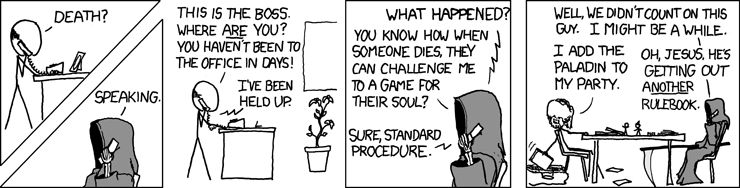
XKCD's tribute to Gary Gygax


My game group faces a couple major challenges when it comes to actually getting any game-play in:

  1. We are all very busy adults, most with full-time jobs and/or school obligations.
  2. We play on a weeknight and because of challenge #1 have a limited window between the end of work and a reasonable bed time.
  3. There are seven (well, six now)* players in my group. This is almost twice the size of the model gaming group towards which the rules of D&D are balanced

All of these factors combine to make the efficient execution of our game sessions an absolute necessity.

I have established a couple of techniques to help streamline my sessions in order to maximize everyone's chance to play and have fun.

First off, here's what I don't do...

I do not restrict the amount of non-game related conversation at the table (within reason). Our group gets together as much to socialize as it does to play games, and so catching up with friends is part of the overall experience, and part of the fun.

On to what I do...do...

  • I make use of an initiative tracking system that is visible to all my players. (For the lay-person, initiative = who's turn is it?) It's amazing how much a system like this can reduce player hesitation when it comes to their turn. It also all but eliminates the problem of players being in the bathroom, or out for a smoke when their turn comes up.
  • In tandem with the visual initiative tracker, I also use a sand timer to mark our current spot in the initiative rotation. The rule I established says I flip the timer when each player's turn begins and if they haven't started telling me what they want to do by the time it runs out, their character is hesitating until the next round. I generally don't enforce this rule very strictly, but if hesitation becomes a problem, the timer gets flipped.
  • I try to give my players breaks when appropriate. This may seem counter-intuitive, and has actually backfired on occasion, but telling the players to take five while I set up the next scene will help them return to the table focused and ready to play, and will give me room to set things up.
  • I keep an eye on my own clock. This is a relatively recent development, but I have started setting target times for the scenarios I write. The system can only really be used as a guideline, because I don't want to cut a scene short if my players are having fun.
  • In conjunction with the above system, I have started employing Dave Chalker's concept of an "out" in combat scenarios to both add flavor to a fight beyond, "kill them all and go through their pockets" and simultaneously move things along.
  • I have also implemented a psychological experiment that seems to work quite well. I gave my game a theme song. At the beginning of each session, as dinner is wrapping up, I start the music. My players have developed a sort of Pavlovian response to the music, which signals that the time for chatting is done and the time for face smashing has begun.
These techniques all go a long way towards speeding up gameplay without forcing the situation. As such, my group can typically get through two to five different encounters over the course of a three hour play session. Sometimes, if they are in a particularly tough boss fight, or are enjoying free form shopping trips to spend their ill-gotten gains in town, we might only get through one actual scene. The important thing is that everyone is having fun!

*One of my players is in a very rigorous course of study in Chinese medicine and has had to bow out due to her workload. We are currently in the process of phasing out her character.