Showing posts with label streamlining. Show all posts

Friday, June 3, 2011

The Rule of Fives!


First off, L.G. Smith over at Bards and Prophets tipped me off to a new blogfest that looks to be right up my alley.

However, since this blog makes my favorite game pretty apparent, I think that I will instead post about some awesome game night alternatives. Keep an eye out for Monday’s post.


So, last night was game night and my group was properly lured into a sense of complacency, having just killed a big ol’ dragon, so what did I do? I threw a rampaging horde of orc barbarians at them! YAY!


Anyway, I had really been wanting to try my hand at running a defensive encounter, similar to this one. In the typical D&D format, players are usually the invaders, breaking in to the homes of unsuspecting monsters who are just trying to mind their own business and eat a few villagers. Well, I decided to turn the table on my players, giving them two days warning of an approaching horde of orcs. They had to prep their defenses and hold them as long as they can.

Now, as implied by the word “horde”, this encounter included a LOT of combatants, which has the potential to severely bog down the play rotation as the GM has to resolve every roll made by every creature not controlled by a player.

To make my job easier and keep the pace snappy, I devised a mass-combat system, which I have dubbed the “Rule of Fives!” Now, five seems to be a magic number for DMs. There are a variety of planning techniques based around fives, from the five-room dungeon to the myriad of applications of the five-by-five technique. My Rule of Fives, however, is different.

In summary, this rule takes the base hit points of every NPC and monster, and makes it a multiple of five. More importantly, whenever damage is dealt to that NPC or monster, it happens in multiples of 5, with each 5 being recorded as a check-mark on my combat tracker (i.e. 1-5 hp = ✓, 6-10 hp = ✓✓ and so on.) When the tally marks reach the total hit points of the creature divided by five (e.g. ✓✓✓✓✓ for a 25 hp monster), it dies.

The Rule of Fives simplifies the mental math every GM must churn out down to the quick and easy task of counting by fives. However, it still accounts for variation in the amount of damage dealt by different attacks (i.e. a fireball can kill in one hit, while an arrow is unlikely to do so.) When implementing the rule last night, I combined it with a couple other shortcuts to speed things along. The first was my random attack roll sheet I mentioned back in April. The second is a simple mechanic, whereby NPC minions only deal a single ✓ of damage to each other when making basic attacks. Big spell effects are different, but this rule works well for arrow shots and sword hits. This also helps emphasize the importance of the players. They are the heroes. They deal the most damage, and they can dramatically swing the tide of battle.

Anyway, the system worked beautifully last night, and we got through an entire combat session at the players’ first defensive line, and the group killed almost 20 baddies in an hour. If I had hand rolled everything, I doubt we would have made it through a single round.

You know what? three can suck it, five is the new magic number!


Friday, April 22, 2011

S is for Session Streamlining

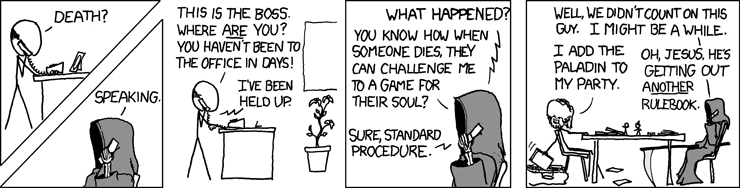
XKCD's tribute to Gary Gygax


My game group faces a couple major challenges when it comes to actually getting any game-play in:

  1. We are all very busy adults, most with full-time jobs and/or school obligations.
  2. We play on a weeknight and because of challenge #1 have a limited window between the end of work and a reasonable bed time.
  3. There are seven (well, six now)* players in my group. This is almost twice the size of the model gaming group towards which the rules of D&D are balanced

All of these factors combine to make the efficient execution of our game sessions an absolute necessity.

I have established a couple of techniques to help streamline my sessions in order to maximize everyone's chance to play and have fun.

First off, here's what I don't do...

I do not restrict the amount of non-game related conversation at the table (within reason). Our group gets together as much to socialize as it does to play games, and so catching up with friends is part of the overall experience, and part of the fun.

On to what I do...do...

  • I make use of an initiative tracking system that is visible to all my players. (For the lay-person, initiative = who's turn is it?) It's amazing how much a system like this can reduce player hesitation when it comes to their turn. It also all but eliminates the problem of players being in the bathroom, or out for a smoke when their turn comes up.
  • In tandem with the visual initiative tracker, I also use a sand timer to mark our current spot in the initiative rotation. The rule I established says I flip the timer when each player's turn begins and if they haven't started telling me what they want to do by the time it runs out, their character is hesitating until the next round. I generally don't enforce this rule very strictly, but if hesitation becomes a problem, the timer gets flipped.
  • I try to give my players breaks when appropriate. This may seem counter-intuitive, and has actually backfired on occasion, but telling the players to take five while I set up the next scene will help them return to the table focused and ready to play, and will give me room to set things up.
  • I keep an eye on my own clock. This is a relatively recent development, but I have started setting target times for the scenarios I write. The system can only really be used as a guideline, because I don't want to cut a scene short if my players are having fun.
  • In conjunction with the above system, I have started employing Dave Chalker's concept of an "out" in combat scenarios to both add flavor to a fight beyond, "kill them all and go through their pockets" and simultaneously move things along.
  • I have also implemented a psychological experiment that seems to work quite well. I gave my game a theme song. At the beginning of each session, as dinner is wrapping up, I start the music. My players have developed a sort of Pavlovian response to the music, which signals that the time for chatting is done and the time for face smashing has begun.
These techniques all go a long way towards speeding up gameplay without forcing the situation. As such, my group can typically get through two to five different encounters over the course of a three hour play session. Sometimes, if they are in a particularly tough boss fight, or are enjoying free form shopping trips to spend their ill-gotten gains in town, we might only get through one actual scene. The important thing is that everyone is having fun!

*One of my players is in a very rigorous course of study in Chinese medicine and has had to bow out due to her workload. We are currently in the process of phasing out her character.