Showing posts with label over-scheduling. Show all posts

Friday, March 22, 2013

Get Rolling: Starting with RPGs pt. 4 (The Time Thing)


Happy Friday everyone! This is the fourth post in my ongoing series about getting started with RPGs from the perspective of a busy adult. If you haven't already, you might also want to check out part 1, part 2 and part 3 of this series.

Today, we will tackle the challenge of gaming on a busy schedule. To that end, I am writing this while on my lunch break at work. How apt.

The first thing I will say to those of you concerned about whether you can fit gaming into your busy schedule. IT CAN BE DONE! When I first returned to gaming as an adult, I was balancing a full schedule of grad school and work. Now I am actually running a game while also working full time and helping my fiancée plan our wedding this summer. The fiancée, who is also one of my players, has a very demanding job, takes ballet and yoga classes and is shouldering most of our wedding planning tasks. I have players who went through grad school or college while playing in the group. All hold down jobs and have very busy extra-curricular lives that involve, among other things, spouses, gardening, sports watching, tutoring, dancing, skiing, Rubix cube solving (like on an internationally competitive level)...and on and on. We. are. busy. Yet we still find time to game.

How do we do it? I'll get to that. First, I need to go over how much time it actually takes to game. The commitment for players is fairly straightforward. In most groups, the players just need to show up on game night ready to play with their character sheets and dice in hand. That's it.

The actual time involved to achieve this depends on the structure of your sessions. Do you play weekly? bi-weekly? Do you do an all day binge one weekend a month? Figuring out the schedule for your game sessions (how long and how often you play) is something that should be hashed out with everyone in the group participating. In general, though I suggest a minimum of 3 hours play time per session (enough to get through 1 or two encounters) with sessions scheduled weekly, bi-weekly or monthly. If you can swing it, you'll get a lot more done in 4-6 hours, but that might not be doable on a busy schedule.

For the GM, the time commitment is typically much greater than for the players. When I was first starting out, I read several articles stating that you should be able to plan a 4 hour game in 1 hour. After four years of GMing, I have yet to hit that mark. Most of my planning time involves scratching my head about what I actually want to do. Once I get down to writing, then it might only take an hour, but there is a lot more brain time involved. In general, I probably spend 4-8 hours a week working on game prep. Now, this time could be significantly shorter if I were running a pre-published setting and/or adventure.

Now for the nuts and bolts of managing game time.

1. Acknowledge that real life comes first!

It may seem odd to have to say it, but I often have to pause and remind myself that it is just a game. People get too busy to play, have last minute things come up, get sick, go on vacation, work late, get stuck in traffic. Real life intervenes on a regular basis and it is important to remember what takes priority. If everyone in the group is respectful and understanding of this fact, chances are, you will do a much better job of finding time to play.

2. Have a clear, consistent schedule

Keeping a busy group rolling requires a predictable schedule. How often will you play? How long will you play during each session? Do you have a hard stop time or do you play until you reach a stopping point? Will there be food? All of these questions are important to answer so busy players can work game night into their schedule with confidence that it wont intrude on other commitments (see rule 1) We play from 6 to 10 pm every other week. Our sessions start with about an hour of dinner and social chatter before the game actually starts around 7 pm. We try to keep our game night on the same night each week, though it has bounced back and forth between Wednesdays and Thursdays over the years before recently shifting to Mondays.

For busy groups, I would recommend avoiding weekly games. This leads to GM and occasionally player burnout. On the flip side, if you leave too much space between sessions, players can lose the continuity of the story and much of your time will be spent recapping what happened.

3. Be Flexible

The other side of having a clear schedule is knowing if and when to change that schedule. This involves two things. Dealing with the temporary disruption of absent players, and dealing with longer-term schedule changes. I have said this before. One of the most valuable things I did for my game was to establish clear rules for handling absent players. We only cancel a game if half or fewer of the group can make it to game night. If that is the case, we first try to find an alternate day. If that doesn't work, we cancel.

For longer term schedule changes like someone shifting work hours, it is important to have a way for the group to discuss an alternate schedule. I like to use a Doodle survey in such situations. This allows me to clearly see who can make which days/hours and to adjust things in order to benefit the largest portion of the group.

If you stick to these three rules for running a game, the time commitment should be fairly similar to taking a class, playing a sport or being involved in any other regularly scheduled activity. For a GM, it is actually going to be more like coaching a regularly scheduled activity, but because this post is starting to run long, I will address the rare and peculiar beast that is timely game prep in a later post.

Thursday, October 4, 2012

Dropped Projects: When the Old Shiny Becomes New Again

What's this!?
I know I'm a day late, but this is my post for this month's Insecure Writer's Support Group

Old projects, why can't I quit you?

I have noticed that my behavior pattern when it comes to creative projects/hobbies tends to run like so:

  1. Discover new and exciting activity
  2. Get really enthusiastic about and put a lot of effort into activity
  3. Get frustrated or bored with the imperfections that become apparent in activity
  4. Drop activity in favor of newer, shinier activity that looks more promising
  5. Time passes
  6. Notice old activity again
  7. Get that old excited feeling
  8. Remember how the excitement wore off
  9. Hem and haw about whether to pick up old activity again
  10. Repeat from step 1


Seriously, it is the exact same pattern as an abusive relationship! I can point to many specific activities that I have picked up, danced with and discarded in this fashion, including the following:

Monday, December 12, 2011

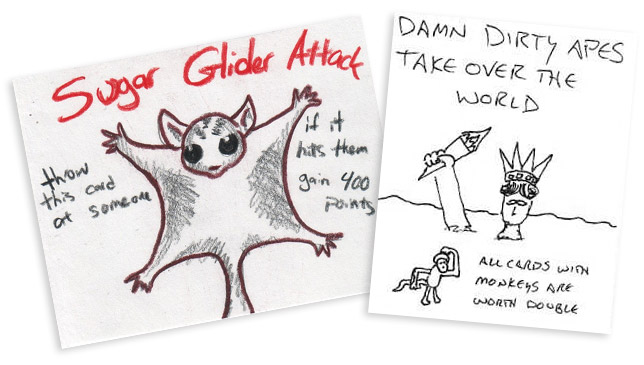
1000 Blank White Cards

http://dicehateme.com/2010/12/gamesbible/

Ah, the holiday season. 'Tis the season for family, feasting and parties. 'Tis also the black hole of gaming. As holiday schedules fill up, maintaining a regular tabletop gaming routine becomes more and more difficult. Many groups find the prospect of holiday game scheduling too daunting a task to overcome. They choose to risk the dreaded "hiatus" slumbering through to hopefully reawaken in the new year. My group has been fortunate in the three years we have been together. We have never needed to put things on hold during the holidays. This year, however, our schedule is rougher than usual. We have postponed and skipped several game sessions, and I must admit my scheduling nerves are becoming a bit frayed.

A couple weeks ago, we were faced with a last-minute player shortage and the question of how to proceed. Rather than calling off the game for the night, I decided to scratch an itch I had been having to indulge in some collaborative world-building using 1000 Blank White Cards (1KBWC). If you are unfamiliar with 1KBWC, let me bring you up to speed. The game is born of the same imaginative strain as blanket forts and broomstick ponies--the comandeering of utilitarian objects for the purpose of imaginitive play.

The basic 1KBWC game begins with a box of ordinary, blank index cards. Players jot down items, scenarios and other imaginings and then assign them a point value from -100 to +100 and/or make up a rule associated with the card. Examples:

  • Party Foul! You spill your drink on your cards! -20 points and discard your most valuable card.
  • Baby-sized Burrito +40 points
Card contents are created on the spot before play begins and are only limited by the imaginations of the players. The cards are then dealt and played around the table with each player playing a card on either themselves or on another player... because players gonna play. The objective is to end the game with the most points.

Well, Matthew Neagley over at Gnome Stew has written a couple posts on his use of the 1KBWC format for collaborative world building. This variant of the game begins as the players of a tabletop gaming group jot down  things they would like to encounter in their ideal game world. These can be treasures, villains, fantastic locations or anything else that pops into mind. The best ideas are usually simple and not terribly specific. Complexity and specificity come as the game progresses. 

Once the cards are written, shuffled and dealt, play proceeds as in the standard game, except that the cards are played on the table rather than against particular players. Cards can either be laid down on their own or used to build on a card already in play. As the game proceeds, the clusters of cards develop into potential plot seeds and adventure locations. If you like, their placement on the table may also serve as a rough geographical orientation within the game world. My particular group chose to ignore the spatial component, but came up with some amazing ideas that may very well appear in future adventures.

Some example clusters include:

Cluster A:
  • underwater fortress built into the side of an undersea volcano
  • lizardmen cult
  • mechanical plesiosaur submarine
  • sentient coral
  • the kraken
Cluster B:
  • golden colossus
  • lava lake
  • trees made of fire
  • rebel group of good-aligned devil warriors
  • hammer of the gods
The exact associations within each cluster are ultimately up to the GM to flesh out, but both of the examples above could easily be expanded into an adventure. 

Playing 1KBWC was an excellent alternative to canceling a player-short game night, and I encourage my fellow GMs to give it a try. Our group had a lot of fun watching these cards coalesce into the birth-goo of adventure, and I do not doubt that I will catch excited glimmers of recognition if and when the ideas we generated work their way into my game.

Friday, October 21, 2011

Overscheduled


My girlfriend and I frequently have discussions about scheduling and over-scheduling. While we have many things in common, which cause us to like each other (like, like-like), we also have several distinct differences. One very prominent difference is that she is a "planner" She likes her schedule orderly and full. If she hasn't started working on her Halloween costume by August, she starts to get nervous. She fills her week with classes, dinners with friends and other forecast events weeks and months in advance.

By contrast, I prefer to take a more casual approach to my activities. I can handle one or two weekly commitments, but I like having the option of sitting on my butt in front of the tube if I'm exhausted from work. I don't want to put myself in a position where I feel forced -dare I say, "railroaded?"- to hang out with friends or do something I would otherwise enjoy if I were approaching it on my own terms.

So, why this ramble about relationships and personality differences? Well, I realized during last night's D&D session that player characters in an RPG can be overscheduled as well. As a DM running a weeknight campaign (3-3.5 hours of play with a hard stop time) I get really wrapped up in moving the story along. I want to get my players to the next boss fight, the next town, the next big reveal. I worry that the pace of the story is dragging, so I crack the whip in my head and bellow, "Hyah mule! I say, Hyah!" In short, I regularly try to squeeze too much play time into our play time!

You have three waves of orcs to defeat before piano lessons mister.
You're having fun, dammit!
Last night, it finally hit home that much of my recent malaise over my campaign might be because I overfill my sessions. While I try hard to avoid railroading my players, to give them options for approaching different situations, when I try to fit four encounters into a three hour session, I find myself getting impatient when my players start deliberating over those options. My irritability starts to show, and my players don't get the time to reach some of their more creative and innovative ideas. The play starts to feel hack and slashy and downright bland.

Well yesterday's game was different. I didn't let myself worry that we have only been playing three hours a month for the last three months. I didn't try to force things along quickly and I presented my players with several very open-ended situations:

  • You know you are traveling through hostile territory, what's your plan for avoiding detection?
  • You know you will have to cross the enemy lines, how do you want to do that?
  • You've been discovered by a patrol that is suspicious of your alibi, how do you respond?
  • You've made it through the initial checkpoint, but need papers and/or authorization to make it through the next one, how do you get them?

Most importantly, however, I allowed my players the time to discuss their plans for answering each of these questions before moving on. I felt like the game play last night had a creative spark that has been dampened for a while. My players were thinking both inside and outside the box, and when I inevitably poked at the holes in their plans, they were quick on their feet to try and plug the gaps.

half-orc monk: "Oh, hey Mr. patrolman, I wasn't hiding behind this tree, I was just having a piss, what can I do for you?"

Loosening my death grip on the schedule for the night made the game actually feel fuller, like we got more done than during sessions where I line up the encounters like dominoes. Bonus: My players got to a great cliffhanger stopping point, which was right where I  was hoping they would end the evening. I liked that feeling. I was happy to be a part of it.

So, the plan moving forward... maybe... if I feel like it... is to worry less about driving the plot forward by cramming in the encounters, in favor of preparing to meet the creative approaches my players dream up.