Showing posts with label inspiration. Show all posts

Monday, November 25, 2013

Make-it Monday: Mini Painting, Dwarf Base Coat and Old School Birthday

So, my birthday was last week, and this weekend we threw a little shindig over at our place with food and board games. A couple of my friends even got me presents, and a lot of those presents just happened to be game related.

One friend got me an awesome set of brushes to add to my mini painting kit.

The angle brushes are awesome for getting into the hard to reach bits.
Of course, I couldn't pass up the opportunity to them out, so I busted out the Bones once again, and put a base coat on a dwarven fighter mini.


I'm basing the color scheme for this mini around a bronze palette, which so far is seems to be a nice change from the typical gunmetal/silvery chain mail and armor that seems to be my default. I also think I finally got my brain to shift away from worrying about being perfectly tidy on the base coat. Ultimately, it is more important for that initial layer to have thorough coverage than it is for it to have clean edges. Once you get that first covering, you can more easily go back and tidy things up.

Unfortunately, I can only do so much in one sitting before my hands get tired and my eyes start crossing, so I'll need to leave it where it is for a day or so before continuing with more base touch-ups and highlighting.

Blast From the Past

The other gaming presents I got were only sort of birthday presents. I have found that one of the advantages about being an out-and-proud dice dork is that former dice dork friends will occasionally offer up some of their old kit that they don't plan to use anymore. Such was the case when a couple of my friends mentioned that they had old D&D 2nd edition material they were looking to get rid of. One of these friends did package his set of books as a birthday present, while the other delivered two boxes of box sets to my door after about a month of delivery tag (if that's a thing?)

I actually took the Monster Manual upstairs to read before bed... just like when I was a kid.
Anyway, I'm just glad I have a nerdy and understanding Wife who indulges my habits, because this stuff is 
  1. unbelievably awesome inspirational material
  2. not likely to get used for their main purpose (as game modules) any time soon
  3. voluminous enough to nearly double the linear footage of my D&D catalog
Despite the fact that I don't think I'll be rolling a 2e game anytime soon, I've been flipping through the books and have already discovered a couple elements that I might even be able to work into the next game session. One of the truly wonderful things about inspiration is that it is not affected by new editions and rule changes.

Wednesday, October 16, 2013

Make-it of Days Past: Map, Amak Tor and Surroundings


I am on the road this week, so you are getting the travel edition of ROFL Initiative. I rolled for random encounters during my trip today and got one delayed flight, which lead to several extra hours tacked on to my travel time.

Anyway, mapmaster, Dyson Logos has been encouraging everyone on G+ to post mapping creations from their pasts. So I have. Here is another map from my very first game world, that I created back in high school. This map doesn't have quite the polish of the one I posted last week. My river placement and coloring are much sloppier.

One thing that is interesting about this map is that the place names really show the influence that David Eddings was having on my high school self. The heavy use of "K"s in the place names on this map indicates that this is bad country. 


In other news, if you have ever wondered what it takes to start up a video game company, I recommend you check out my buddy Charles' blog. He's been producing games for the likes of Microsoft and Sony for over a decade, but set out on his own recently to start his own company. His blog is tracking the earliest stirrings of his newly full time company. If you're interested in reading about what it takes to get into games AS IT HAPPENS, I highly recommend you check out his shizzle... and his blog.

I've got more maps, more costume updates and a recap/how-to for running an encounter centered on a feast or celebration all in the works, so stay tuned!

Friday, October 11, 2013

Mapping Habits: Cartographic Zoolander

Current Game

High School Game

As I was poring over the recovered maps, notes and drawings from my recently rediscovered high school gaming binder, I noticed something interesting. The map of my current game world bears an uncanny resemblence to the nearly 20 year-old world map from my very first game! Both maps feature:
  • A western ocean 
  • A main coastling running north-south
  • Clusters of islands off the coast 
  • A verdant central landmass  
  • A large mountain range that wraps from the north around along the eastern edge of the map 
  • A desert on the eastern slope of the main mountain range
  • A smaller coastal mountain range
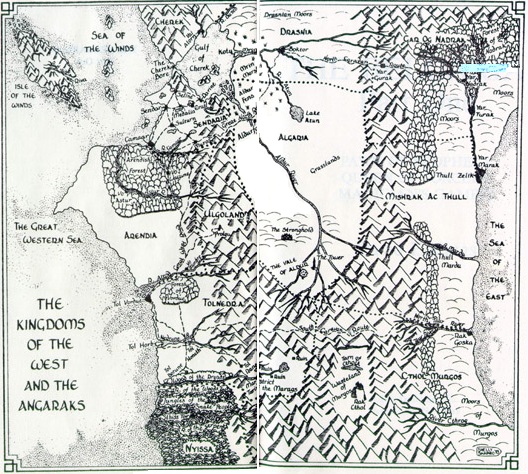
As I thought about this situation further, I started to also notice uncanny similarities in other major fantasy settings. While these settings may not have all of the features mentioned above, they all include a prominent western ocean, and often several of the other features. Take a look at the following maps and tell me there isn't a striking family resemblence!

Tolkien's Middle Earth

The Sword Coast from The Forgotten Realms

The Kingdoms of the West from the Belgariad

Terry Brooks' Shannara

Robert Jordan's world from the Wheel of Time

Brian Jacques' Mossflower

IT'S THE SAME FACE!

I FEEL LIKE I'M TAKING CRAZY PILLS! Why!? Why do so many of the characteristics in these maps overlap? What compels all of these various authors, myself included to assign similar spatial structures to their worlds? I have a couple possible theories...

Wednesday, October 9, 2013

Make-its of Days Past: Map and Airship Diagram

I've been going through a bunch of boxes retrieved from my family's storage unit, and recently stumbled on the most amazing thing! My DM binder from THE VERY FIRST D&D CAMPAIGN I RAN BACK IN HIGH SCHOOL!! This is vintage gaming gold from the days of 2e folks! Of course if I recall, the campaign lasted all of two or three sessions, but the world-building was pretty epic.

Here is a map and an airship drawing that I scanned from the binder for just a little taste of the stuff I unearthed. Check 'em out! I'll probably upload other bits I find as I get my old notebook reorganized. Who knows, I may try to incorporate some of this stuff into my current game.


Friday, September 20, 2013

Layers of Places Past: Creating Ruins with Purpose

The BIGGEST Henge in the WORLD!
This is yet another post for CampaignMastery's Location blog carnival! Hope you enjoy!

Today, I am going to elaborate on an excellent suggestion from Realmwright on my previous post. I am going to talk a bit about why ruined locations show up where they do, and how their past might inform their present desolation.

The fantasy genre in general, and fantasy games in particular, spend a lot of time focusing on places from the past. Authors like Tolkien and Terry Brooks build their worlds around elaborate histories of rise and ruin. Characters in videogame and tabletop RPGs spend much of their time poking through lost catacombs and ruined castles. The thing is, all that was old was new at one time, and when it was, these ancient places likely served a purpose.

I have a love-hate relationship with many dungeon maps, especially those which follow an old-school aesthetic. Maps are a lot of fun to look at in general, to imagine what a place or space really looks like based on its top-down representation, and old school dungeon maps have an elegant simplicity about them. The problem is, they often seem to be a tangle of rooms and corridors built for no discernible reason!

Now, where the heck is the bathroom?

Sure, the person who dreamed up the dungeon, always says there's a purpose. The map above is clearly a temple of the ancient Blue Oyster Cult. The architecture of Blue Oys is often characterized by its meandering lines and maddening lack of doors in places where they should exist. Archaeologists believe the structure was designed to amplify the sound of the cowbells used in the cult's mysterious rituals.

Seriously, though, who builds like this!? And "insane wizards" is an answer that you can get away with exactly once in your game! I'm looking at you, Undermountain!

This kind of random dungeon layout, while interesting to look at in a circuit board kind of way, really drives me nuts. If you haven't read it yet, Bartoneus, over at Critical Hits has created one of my absolute favorite blog series, called The Architect DM, which is all about creating fantasy designs with a purpose and is a useful way to counter the random dungeon sprawl. I highly recommend you read it, bookmark it, and reference it often when creating your own locations.

When I approach the design of a ruined structure, I always try to start before it was a ruin. I ask myself the following questions:

Wednesday, September 18, 2013

Placing Settlements in your Game


While world-building, I often find myself fretting over doing things "right". Making sure I have the "right" population for a city of a certain size, the "right" number of soldiers in an army, even the "right" number of bakers in a town. Why do I care!? The players will never interact with the bakers, much less conduct a census with the sole purpose of calling out my poor planning... yet, I fret.

It's just who I am. I want things to have a reason. To not be scattered higgledy-piggledy and just poured in without rhyme or reason.

Well, today I want to explore one particular manifestation of this demographical mania, and the system I use to address it. I would like to discuss how I decide where to place a settlement while world-building. Ultimately, the whole system boils down to one question, "why settle there?"

There are several possible answers to this question, but I assume one thing to be true in all cases. People always have a reason to settle down. They rarely just stop in the middle of nowhere, unless they have a reason or several reasons. There are many different reasons a settlement might spring up, and the reasons for a particular settlement can also often shed light on its character.

So, if you are plugging away at a world atlas for your game or novel, giving some consideration as to why a settlement formed can, in turn, help flesh out the tone, denizens and other elements of the location as well.

Here are some of the possible reasons that could lead to the formation of a city.

Friday, September 13, 2013

Pinteresting Locations


I am a busy dude, and as I have become more experienced at running my regular D&D game, I have found myself trimming the fat from my prep time whenever possible. One of the best tricks that I have added to my DM toolbox deals with creating locations. In the past, I would spend hours, if not days or weeks painstakingly dreaming up and then drawing out the maps for location-based encounters. I would agonize over whether the dimensions for different vertical levels in a structure lined up properly, or whether there were enough fields around a city to maintain its population. I really didn't have time for that kind of crap, and my players didn't really pay attention to it. They wanted cool places to get into fights, and that's it.

Then I realized, why spend all that time fighting writer's block to dream up totally unique places, when you can draw inspiration from the fantastic places already out there!? I set up a Pinterest board called Gamespiration, and over the months that I've had it, the board has filled up largely with photos and illustrations of fantastic locations. The pictures are great for breaking through creative blocks that might otherwise result in yet another fight in an 8x8 room with a couple pillars.

Let me give you an example of how I pulled several existing images together to inspire the location where the final climactic episode of my last campaign took place.

First, I knew I wanted the battle to take place outside a ruined city on a plateau up against a glacier, out of which were running rivers of blighted water. But drawing a city map can take FOR-EV-ER. So I looked around until I found Ani.


I kept the basic shape, changed the fortifications at the north edge to the foot of the glacier and converted some of the landmarks into sites appropriate for my particular ruin.

I also knew I wanted a Helm's Deep style fortress set into the foot of the glacier, so I grabbed this image and a couple others for visual inspiration.


I also grabbed this one for a top-down map.


I ignored the underground cutaway on the bottom of the map, replaced the steps and altar at the top with a keep, and added a few more breaches in the walls from time and previous battles. All-in-all the modifications were much quicker than dreaming it up from scratch.

When my players headed to the ruined city to scout things out, they went poking around in some ice caves looking for a back entrance to the mines they thought might be the source of the evil blight. I took my inspiration for the cave environment from this image.


The beautiful thing about using Pinterest to inspire location is that you can draw from rich visual resources, which can add depth to your locations' descriptions, or even just be shown at the table. "You enter an icy cave that looks like this."

You also can be laying the foundation for incredible locations outside of your prep time without disrupting your usual activities. Anytime you see a cool or potentially inspiring image on Facebook, in an article you're reading or anywhere else online, you can just use the Pinterest plugin in your web browser to toss the image onto your board. When it comes to prepping a location, you then have a one stop shop to get things rolling!


Wednesday, September 11, 2013

Puzzling Locations

We're back to talking about locations for the Campaign Mastery blog carnival, and today I want to talk about puzzling locations!

I love logic puzzles, and as a GM, I love working puzzles into my game, and location-based puzzles can really add a sense of magic, danger or novelty to an encounter. Wrestling with a good brain bender can also be a nice change from a dungeon's hack-and-slash grind. You might worry that coming up with good puzzle encounters is something only some sort of mad genius puzzlemancer could achieve... Not so, my friend!

I have a simple trick for making location-based puzzles that I have used several times to good effect, and I'mma share it with you now.

Step 1. Figure out the basics of the encounter. Where do you want it to be? What are the PCs trying to achieve?

Step 2. Find a standard, off-the-shelf logic puzzle that you think might fit well within the situation.

Step 3. Convert the logic puzzle to work with elements of your location.

Step 4. (optional) Add a twist for a greater challenge or flair.

Here are a couple examples that I have used in my game.

Example 1. The Gates of the Forest

A Map I did for this encounter.

Step 1. The encounter took place at the entrance to a sacred druid grove. My players were trying to gain entrance.

Step 2. I wanted to make them solve a puzzle to get past the gate. After some searching, I settled on the classic frog hopping puzzle.


Step 3. I presented the puzzle as a set of stone frogs and birds, which appeared within a glowing aura on a pedestal outside the gate.

Step 4. In order to add a bit of challenge and to ensure that more than one player would be involved, I added a second pedestal high up in a tree above the gate. Only half of the pieces could be controlled from each pedestal. This meant one or more of the players had to get up the tree to the other set, and then communicate back and forth to move the pieces in the proper sequence.

Example 2. Across the Chasm

For those who don't know, this is a beholder. -by LIKA--Elvennight1999
Step 1. My players were pursuing a lesser beholder back to its lair. Because it levitates, it naturally chose to sequester itself across a massive underground canyon in a spot where land-bound creatures couldn't harrass it.

Step 2. I wanted to make getting to the lair a puzzle challenge. I selected an unblocking puzzle to serve as the challenge.


Step 3. Since the players were trying to fly across a canyon, I converted the blocks into magic floating platforms. Only one platform was lined up to properly fly across the canyon, and it was blocked in by all the others. The players moved the blocks by hopping onto them. Once they got the right block free, it carried them across the canyon.

Step 4. I didn't really add much of a twist to this one.

Example 3. Rigged to blow

The Seven Bridges of Koenigsberg is the grandfather of Euler puzzles.

Step 1. My players were returning to a hobgoblin-infested mine that they had previously raided. I thought the hobs would probably have laid a trap at the access point to deter any further intrusions.

Step 2. I wanted the trap to be a full encounter, and not just something for the rogue to solve with a single roll. After some thought, I decided to use an Euler puzzle (a path-tracing puzzle) to represent the sequence of triggers in the trap.


Step 3. I presented the paths as fuses along which a magical charge ran between clusters of blast globes (intersections) that were rigged to collapse the room. To prevent the charges from going off, the players had to smack the igniters just as the charge was arriving and send it down an alternate path. As each path was crossed, that particular fuse burned out, preventing its further use. The players needed to burn out all the fuses without letting three charges go off or the room would collapse.

Step 4. To ensure everyone would participate, I picked a pattern with the same number of intersections as players, and arranged them on platforms scattered around the room. I actually had two players miss their attack rolls to hit the igniter as the sequence reached them, blowing them off their respective platforms. It made for a very tense encounter, and got everybody involved in what could easily have been a rogue and a roll encounter.

So, those are just some examples of ways you can convert classic logic puzzles into location-based puzzle encounters. Now, if you would like to try this in your game, or just want to solve some logic puzzles, here are some places to look!

http://www.brainbashers.com/logicpuzzles.asp
http://www.mathplayground.com/games.html

Friday, August 23, 2013

Campaign Retrospective: Synthesis


Today, I want to talk about where inspiration comes from, and the little voice that tries to stifle it by pointing out how unoriginal your ideas are. I embarked on my first D&D campaign, in part, to prove to myself that I could sustain an interesting story over an extended arc. I like to think that the end result was a pretty unique tale and a unique experience for my players. However, my story was largely crafted by shamelessly ripping elements from existing stories, which I found inspiring.

Now that my first campaign is complete, I feel like I can discuss my inspiration in a bit more detail without spoiling things for my players. This post reveals, in very broad terms, the sources behind my campaign plot, and how I mixed them to suit my own ends.

The idea for the Westerlands began with a combination of two simple things. 1.) My infatuation with Muse's song, Knights of Cydonia, and 2.) My dissatisfaction with D&D's alignment system. I really wanted to create a campaign arc triggered by a Paladin's dilemma, which pit two essentially lawful good forces against each other.

As I began to flesh out the primary arc, I latched onto the rules for blight in the Heroes of Horror book. I decided to use these rules as a backdrop to a plot constructed by forcibly mashing elements from Hamlet into Macbeth. I added a wicked queen who kills a king and then uses her influence with her husband to hold onto control (Macbeth) In my story, she was actually plotting against the king while pushing him towards an evermore tyrannical rule, citing the need for order in a time of crisis. Meanwhile, the estranged brother of the king sets out to find what is causing the mysterious blight while simultaneously looking for the true murderer of the king (latter bit from Hamlet). The conflict builds through twists and turns until the brothers finally confront each other and the estranged prince summons his father's ghost to call out the true murderer (Hamlet). The queen is accused, forcing her to kill her husband to create confusion before making her escape.

With the country reunited, the players were left to deal with the blight. I turned to Conrad's Heart of Darkness to inspire the feel of the long journey into the blighted lands to the East. The players had to move past outposts where strange behavior was becoming more common as human needs ran up against scarcity, fueled by the influence of creeping evil.

Once the party reached the source of the blight in the mountains near an ancient, ruined capital, I turned to Indiana Jones and the Temple of Doom for inspiration. I even had hobgoblin thugees, a corrupted ally and a minecart chase encounter planned. The cart chase never became necessary.

For the final battle, I didn't really draw from specific sources of inspiration, except to mine as many fantasy battle tropes as possible. The speech from Independence Day, an allied army of good vs. an army of evil nastiness, last minute reinforcements showing up to propel the protagonists through to the final confrontation. Flinging magic, squadrons of marauding skeletons, flying beasts… I basically just poured it all in before having the party confront the evil masterminds just as they were attempting to bring their grand plan to fruition.

That is the overall plot arc, but within that story, I drew inspiration from… to name a few:
  • Blazing Saddles
  • The Elenium
  • Ghostbusters
  • Harry Potter
  • Henry IV
  • Invader Zim
  • The Legend of Zelda
  • LOL Cats
  • Mass Effect
  • A Midsummer Night's Dream
  • Naruto
  • Night at the Museum
  • Star Trek


As I progressed through the campaign, and in my personal life went from an unempolyed, single 20-something to a full-time employed, married 30-something, I felt any anxiety about co-opting existing stories begin to fall away. Now, I never copied an existing property in its entirety, but felt no qualms about mining them for good ideas. Not only did this spirit of borrowing lead to a richer story, but it also served as an excellent time-saver while prepping around a busy life.


If you are getting ready to create a fictional story, whether it is a book, a play or film script, or a game, I encourage you to push the harping little voice that accuses you of unoriginality aside, because just as each new child is born of generations of previously existant people, so too can a unique story arise from existing good ideas.

Tuesday, July 30, 2013

Make-it Monday: On Inspiration

The restaurant, the rock and the lighthouse all fit into the doubloon!


The Wife and I just returned from a mini-honeymoon weekend. We drove down to the remote wilds of the Oregon coast in search of some alone time after two weeks of family and wedding madness. We rented out the Japanese Forest House on R-Evolution Gardens' farm near Nehalem. The house and farm are completely off the grid, drawing their power from solar panels on the premises. The forest house was built by one of the farmers from a single cedar tree. It is absolutely gorgeous and secluded. In a nutshell, the perfect way to disconnect after a hectic event like a wedding.
Japanese Forest House
Photo from Air B&B

I have to admit, I was a bit hesitant about the accommodations when we first arrived. Perhaps I was still wound up from a long drive and two weeks of social stress, but my initial impression was that the farm felt like a mix of the commune from the first episode of Portlandia, and the bed and breakfast from So I Married an Axe Murderer. After settling in, meeting the owners at the local farmer's market, and having some dinner, however, I finally began to relax and enjoy my surroundings.

I have always drawn a great deal of inspiration from the natural beauty of the Pacific Northwest. I think part of the reason fantasy literature resonated so well with me as a child was because much of it involved journeys through the wilderness, which I too experienced during my family's weekend getaways to the mountains or small towns around Washington. Even now, whenever I find myself wandering the wilds, my mind begins to to spin visions of fantastic beasts in the shaded woodlands, to reimagine small towns as medieval outposts, and even to hear the sound of footsteps on the forest floor as the heartbeat of the woods itself.

This weekend was no exception. I began planning for the resumption of my regular D&D game, jotting down adventure hooks and plot ideas in my trusty quad-ruled notebook. The Wife and I also discussed the fantasy ecology of rocky coastlines similar to those found along the Pacific edge of Oregon and Washington. We decided such environs would be the perfect haunts for a coast-dwelling griffon variant. The cliff-dwelling beasts could find safe haven in the rocky sea stacks, and food among the sea lion colonies, or perhaps they might hunt giant crabs along the beaches. Conversations like this are one of the many reasons I married the woman!

I also did a lot of reading. I finished the first book of Asimov's Foundation trilogy. I'm trying to decide whether to review that book on its own merit, or to wait until I finish the compendium. I also got through most of Culinary Reactions, a great little treatise on the chemistry of cooking. Finally, I perused a copy of New Treehouses of the World, which was lying around the Japanese Forest House. If you ever want inspiration, you'll find a bunch of fascinating stuff in that book!

Click here to see a photo for comparison
Between the reading, game planning and discussions on nerdly matters, the Wife and I drove around the small towns dotting that part of the coast. We visted Cannon Beach where the landmarks found on Chester Copperpot's map and doubloon point the way to One-eyed Willie's treasure. We also visited the Tillamook cheese factory, which is similar in a lot of ways to an Ikea... of cheese. Finally, I did a bit of sketching, including this doodle of the main room in the Japanese Forest House.

Tomorrow, we both head back to work and the stress of the "real" world. Fortunately, this weekend was just what I needed to face my responsibilities refreshed and ready to go, rather than in a frazzled post-wedding haze.

Wednesday, June 12, 2013

I learned it from watching you!


Dungeon Mastering is largely learned through experience and observation. As you run games, you (hopefully) have a chance to take in what works and what doesn't, learning from your mistakes, tucking away new tricks and honing your skills to a fine +5 edge.

Running a game, however, is very taxing on the ol' brain goo. While in the heat of a session, flailing to hold together some semblance of a logical storyline that your players managed to shred on first contact, it can be really difficult to leave some brain space for reflection. Your whole brain is likely saying things like, "What do you mean you want to know the names of the mad Duke's entire serving staff!?" and "is the spell the cleric just pulled out of obscure splat book 963 subject to spell resistance or no?"... ergo, not a lot of time to process what is and is not working. I can't count on all my limbs the number of times I've reached the end of a session only to look down at my game notes to see something like:

Santiago drinks
Rayne eats some cheese and onions
Lanna on the prowl

While that is quite a lovely haiku, it's not very informative about how the session played out, much less as an analysis of my own DMing skill. The point is, a DM cannot rely on self-reflection alone.

That's where observation comes in. I have learned a lot from watching other DMs, and have picked up bits and pieces of things that work well, and not so well. Some of the things that I have learned and incorporated from GMs I've played with include:

  • Having two DMs alternate games on opposite weeks takes the pressure off of them while making it feel like everyone is playing regularly.
  • You must want to play as much, if not more than your players, or the schedule will fall apart.
  • Causing permanent harm to the PCs is not always a bad thing. It can also make for really interesting roleplay.
  • Taking away the PC's stuff can lead to greater creativity.
  • Sometimes being a bastard helps increase emotional investment.
  • Death is not always the most interesting penalty.
And these are just a few of the things I've picked up... wow, most of those examples make me sound like an aspiring jerkwad! I'm not changing them though!

Getting to the other side of the DM screen, or even to a spot hovering around the table can provide some wonderful perspective on how to improve your own game. Furthermore, watching other GMs is often more valuable than reading about good DMing. Even if the good or bad techniques are not spelled out as explicitly, seeing them first hand in context beats the pants off of reading a list of best practices. 

Lately, I've become rather enamored with watching recorded game sessions, especially those hosted by Chris Perkins. I love the way he manages to walk back retcons* while remaining in character and in the scene. I love that he is so calm, where I tend to be a bit frenetic, and watching how he describes a scene as the events are unfolding. Some DMs, liken watching a tabletop game to watching paint dry, which can certainly be true, but if the game is running well, you're in the right mood, and you're watching for the right reasons, you could learn a lot from a DM.

This GenCon game is pretty cool to watch. 
Perkins DMing with two of the world's most prominent D&D authors as players

Fellow gamers, do you enjoy watching others game? If so, have any particular favorite DMs to watch?

*retroactive continuity or correcting a misread roll after the fact

Friday, May 24, 2013

Ira Glass: On Storytelling

While we're on the subject of inspiration, I thought I'd share this series of videos that Emma Coats (@lawnrocket) shared to Twitter this morning. The videos came as a big help to me, as I was facing a deadline on an article that I was really feeling crappy about.

In the videos, Ira Glass, creator of This American Life talks about what makes a good story and offers some encouragement for those of us who might feel like our storytelling skills are sucking at any given point in time.

If you are looking for inspiration, you might also want to check out Emma Coats' Story Shots Tumbr. She has a great take on the basics of a good story learned during her time at Pixar.

Part 1

Part 2

Part 3

Part 4

Thursday, May 23, 2013

Inspiration Everywhere: The Perks of a One Track Mind

My brain does this pretty much all the time!


I post pretty regularly about various things that have inspired elements of my D&D game, from songs, to movies, to books. Honestly, I can find inspiration in the weirdest places, in large part because at least part of my brain is always thinking about my game, or at least receptive to how things could fit into it. I cannot count the times when I've been hanging out with the Fiancee, and had a conversation similar to this:

Scene: Grocery store produce section.

Fiancee: Hey babe, what's next on the list?

Me: Huh?

Fiancee: The grocery list. What else do we need?

Me: Oh! Sorry! I was just thinking about how fantasy cultures might arrange their shopping displays and experiences. Would affluent cultures use magic to keep their produce fresh?

Fiancee: ...

Me: Sorry, we need bananas.

Fortunately for me, the last year has presented a counterpart experience that goes the other way. For as my thoughts are to D&D, so are my Fiancee's thoughts to wedding planning.

Edith "Little Edie" Bouvier Beale in front of Grey Gardens
Anyway, I had a particularly bizarre moment of gamespiration this past weekend when the Fiancee and I went on a date to see the musical Grey Gardens. If you are unfamiliar with the story, it is based on the lives of the cousin and aunt of First Lady Jackie Kennedy. Nicknamed Big Edie and Little Edie, the mother and daughter were both wealthy socialites living on an estate in the Hamptons called Grey Gardens. Well, Big Edie's husband, Phelan Beale divorced his wife, leaving her the house, but taking his money with him.

The two Edies, who had a tumultuous interpersonal relationship were stuck living together in this huge house with very little money. In the play, the tension in their relationship often focused on the attention of men. Big Edie sabotaged Little Edie's engagement to Joseph Kennedy (fictional addition for the play) and it was implied that she had similarly sabotaged previous engagements (also possibly fictional).

As the years go by, the house falls into squallor, attracts 50+ feral cats, several raccoons and all of the fleas that go with them. The two women are literally reduced to crazy, catfood-eating cat ladies. They are trapped in the house by their poverty and their own dysfunctional relationship.

Believe it or not, the play is a comedy.

Here's where things get extra exciting/weird. While watching the play, my brain starts interpreting the story as a D&D adventure module! What if the two Edies started out as noblewomen living in a castle on some remote heath? The lord of the castle is super wealthy, but notoriously controlling. He leaves to go on a crusade or something, providing his wife and daughter with a stipend on which to live until he returns... but he never comes back. Maybe he's killed in a battle or disappears under mysterious circumstances.

The two noblewomen live off of the stipend as long as they can, but their stubborn fighting and mismanagement of the estate starts to drive away the vassals. The money runs out, the castle crumbles and the two women are reduced to banshae, heard screaming at each other on the cold winds of the heath. They haunt the castle, and each tries to get any visitors to take her side. Any appearance of favor causes the other to fly into a vengeful rage.

Why would anyone go to the castle? Maybe there is a legend that the miserly lord had a secret vault full of his vast personal wealth. The vault remained locked when he did not return. Perhaps he gave his daughter and wife each only a portion of the clues needed to open the lock, but because of their stubborn bickering, they never cooperated to get into the reserve cash. Adventurers drawn to the castle must piece together the clues from the banshae in order to gain access to the secret vault.

Don't get me wrong, I enjoyed the play on its own right, but having my mind happily burbling away in the background on this alternate extrapolation made everything even better! Any of my fellow GMs have weird sources of inspiration? How about the writers that are reading this?

Thursday, February 21, 2013

The Power of Imagination

Original image by Don Dimanlig
The folks at Obsidian Portal tweeted this image yesterday, and I couldn't resist sharing. Imaginative play seems to come naturally for us as kids, but sadly seems to fade as we grow. One of the things I love about roleplaying games is that it re-engages that part of my brain... Granted, I play at home and don't wander around a supermarket pretending the floor is lava... hrmmm...

Wednesday, December 5, 2012

The Creative Doldrums


Being December 2012's post for the Insecure Writer's Support Group

I have been one of those ubiquitous creative funks of late. It's not exactly a block because I know what I need to do to move forward. It's just that none of the creative projects I have sitting around appeal to me. I have several blog topics jotted in my notebook, partially painted minis on my desk, partially written adventures for the next step in my D&D game, and even a really engaging book that I've been picking my way through at a snail's pace. I feel a bit like the despondent child with too many toys, surrounded by fun, but having none of it. Waaaah!

That's not to say that I haven't been doing anything creative. I have occasionally been dabbling here and there. I recently watched a bunch of instructional videos on OneNote and have been using my knew knowledge to reorganize my D&D notes into a more functional system.*  Like everything else, however, my reorganization remains unfinished. To make matters worse, I only feel the faintest spark of inspiration when I'm at work and can't devote time to this stuff.  I have created this handy graphic, which illustrates my current creative process quite nicely.


What do you do to break out of the creative blahs?

*I may even upload a blank copy of my notebook structure, or at least a couple pages in case any of you are OneNote GMs too.

Monday, November 5, 2012

Monday Mash-ups 2: Super Smash!

Even though only a couple folks chimed in on last week's first Monday Mash-up, the conversation in the comments produced some great ideas for characters that left my brain buzzing all week. Therefore, I'mma do it all over again now!

This week's mash-up theme is super heroes and, more specifically, their alter egos:

I love alternate universe and spin-off comic plot lines, and one of my favorites is the Marvel 1602 mini-series.


If you aren't familiar with it, the series places several well known Marvel comic book characters in the world of the late Elizabethan period. Sir Nicholas Fury is the Queen's intelligencer, Carlos Javier is a monk running a school for gifted youth... you get the picture.

I also had the privilege of playing in a Song of Ice and Fire campaign that included NPCs based on super hero alter egos. I recall burining down a bandit camp run by Oliver Queen. Anyway, here is my example to get you all started:

Ayric Lensherr
Sorcerer (Electromancer) Level 10.
Ayric's comes from a racial minority group, who have periodically been subjected to pogroms undertaken by the despotic ruling families of the realms. After witnessing his parents' deaths during one such purging and upon discovering his unique sensitivity to magic, Ayric became determined to use his strength against all who would seek to oppress or control him. Now, faced with a new threat by those seeking to purge the influence and control of magic users from the land, Ayric has hatched a plan to turn the tables and exert his powers over his enemies.

Spell list
I envision skinning all of these spells as some sort of manipulation of either metal or electro-magnetic energy.
L0: Resistance, Detect Magic, Read Magic, Daze, Dancing Lights, Mage Hand, Touch of Fatigue, Open/Close, Arcane Mark
L1: Tensers Floating Disk, Shocking Grasp, Feather Fall, Shield, Hold Portal
L2: Resist Energy (electricity), Glitterdust, Shatter, Knock
L3: Hold Person, Lightning Bolt, Fly
L4: Globe of Invulnerability (lesser), Rainbow Pattern
L5: Telekenesis

Okay, now it's your turn! No need to be as detailed as mine, but go!

Oh, and feel free to add to last week's post as well if the fancy strikes you.

Monday, October 29, 2012

Monday Mash-ups: Blending of the Bands

Check out the other stuff at SILLOF. Very cool!

Call them mash-ups, cross-overs, or whatever you like (just don't call them a comeback) I love genre bending and borrowing/stealing inspiration from sources otherwise unrelated to my particular ouvre.

This post will hopefully be the first of a series of interactive brainstorms which will work thusly:


  1. I present a theme for the week's mash-up and a couple examples.
  2. You all continue to riff on the theme, coming up with your own ideas and adding them to the comments section.
  3. Profit (by which I mean, the post gets archived for later access).


The idea is to build a collection of readymade characters, locations or other ideas that anyone can access if he/she/it's stuck on a particular project... or if anyone just needs a good laugh.

So, here goes! This week's theme is:

Fantasy characters based on bands and/or musicians


Examples:

  • Steely Dan
    • A plate-clad mercenary who uses his trade as a way to travel the world looking for his lost love.
  • Gordon Lightfoot
    • Halfling rogue. Earned a nasty reputation for single-handedly sinking a ship carrying valuable ores for the royal armories.
  • Burrell McHammer
    • Dwarven Paladin tasked with guarding a mysterious treasure to which access is strictly forbidden.
  • Björk Guðmundsdóttir
    • Elven druid from the northlands who can shape-shift into a swan.

Okay, your turn! If folks get into this, I'll keep the Monday Mash-ups going with new themes in the weeks to come!

Friday, October 26, 2012

Sporkchop's Real-World Adventures: Italy Part 2

In this second installment about my adventures in Italy, we'll start to get into some of the specific escapades in which the Fiancee and I were involved. In the posts to come, I will recount a real world adventure and then offer up some ways it could act as inspiration for a game or fantasy story plot.


"Siate molto tranquilla, siamo funghi caccia."

(be very quiet, we're hunting mushrooms)

I had gone on mushroom hunts in my home state of Washington, so I thought I knew what I was getting into. Boy, was I mistaken. Mushroom hunting is serious business in the Italian countryside. One does not simply walk into mushrooms. No, in Italy, a mushroom hunt is a serious expedition, which involves clambering your way through underbrush clinging to steep wooded hillsides, usually far from any noticeable trail.


When mushroom hunting in Italy, it is best to go with a guide, and the best guides may be Italian doctors. Bit of trivia: All Italian doctors are trained to recognize edible funghi. They can tell you the difference between an edible bolete and "Satan's bolete". Fortunately, for us, our guide was Dr. Gaggi.

The Dottore was a compact pain in the butt who looked a bit like a cross between Elmer Fudd and Dr. Werner Klopek from the Burbs. Oh, and the only English he knew, he learned from watching Clint Eastwood and Chuck Norris movies.


The doctor just said something awkward,
though my brain has blocked it out.


Anyway, aside from learning that Italian mushroom hunting feels more like traveling in country than taking a vacation-time stroll, I found out that Italian mushroom hunters are EXTREMELY TERRITORIAL. When you go, you do not speak above a whisper and you sure as hell don't say things like, "Hey! look what I found!" All communication within the group is done by whistles and hand signals...unless, of course, your guide takes off on his own leaving a bunch of tourists stranded in the middle of woodsy nowhere. 


Dottoooooree!?
If you see or hear another group of hunters, you steer clear of them. You also make sure that all of your finds quickly make it into the basket held by the person with the foraging permit.

So, why is mushroom hunting in Italy such an adventure? Well, there's a really awesome selection to be found if you know where to look. I also think there are a lot more mushroom hunters, which bumps up the competition for the best hunting spots. Despite these challenges, the rewards are well worth the effort.


Now, how do I apply this to my nerd world?


For a creative, storytelling sort like myself, my Italian mushroom hunting experience has spawned several ideas for ways to translate and extrapolate it into a fantasy setting. Imagine a remote location known for its supply of some finite resource. It could be mushrooms, crystals, a fuzzy and delicious breed of hamster. Whatever it is, the competition over this resource is key to unlocking adventure. Perhaps there are rituals or regulations around how this resource can be gathered. The presence of an ambitious diviner or druid magically pointing out where things can be found might cause some tension among those who favor more traditional... and less effective methods. Perhaps one local is known for closely guarding the secret to his/her success in the foraging field. How far would that local go to keep the secret? Maybe an outside force, be it monster, weather or plague is depleting the supply. How would that reduced access affect the locals' behavior and well-being?

The potential plots arise like porcini poking through the loam.

Happy hunting.

Monday, October 1, 2012

Costume Business

The fiancee and I do not partake in cosplay, nor do we LARP. However, we are both HUGE fans of Halloween--her moreso than me. Over the years, the Halloween season has consistently been one of those relationship benchmarks which defines the character of our year.

"Hey, which year did we go camping on the coast?"
"Oh, that was the summer before we were Sweeney Todd and Mrs. Lovett... so, 2009"

Halloween is a big deal for us, and if the fiancee hasn't started pestering me for costume ideas by July, we're behind schedule.

This year, we are definitely behind schedule, having just come up with our final plan this weekend. Nevertheless, we have decided to tackle perhaps our most audacious costume project thus far. Our decision came about during a drive to the grocery store and a conversation that went something like this... ahem...

Fiancee: "I think we should look for a more general theme for our costumes this year... like when we were mad scientists. When we pick specific characters, we always end up struggling to match the costumes exactly and have to blow money ordering replica Sweeney Todd razors or something."
Me: "I agree."
Fiancee: "We need to make a costume decision this weekend!"
Me: "Yeah, I know."
F: "Okay, so what do you look for in a Halloween costume? What gets you excited about making a costume?"
M: "I like costumes that involve LEDs."
F: "I want something with a fabulous wig, and maybe an awesome sword." (Reason # a bajillion why I love this woman)
Thoughtful pause
M: "You know, this might be biting off a lot at this point, but... what if... we went as some sort of futuristic warriors, like with tech armor and crazy glowing swords. We could be... galactic centurions."
F: "YES! We're doing this!"

So, we got home and I popped on to Hero Machine to draft a concept for my costume. For those confused by the term, "galactic centurion", this is what I'm thinking.

Galactic Centurion Concept made with HM3

We also discovered that the internet has a wealth of information on building DIY foam armor!


Thus is our project for the month is defined. I will try to keep you posted as things progress, but for the time-being check out our related Pinterest board! I now leave you with this assortment of images from our Halloweens past.

2011: Action-Serial Air Pirates

2010: Axe Cop and Dinosaur Soldier
2009: Sweeney Todd and Mrs. Lovett

2008: Mad Scientists
2007: Robot Lincoln!
It was images of this costume that first convinced the future fiancee to respond to my emails.