Showing posts with label acting. Show all posts

Wednesday, March 7, 2012

The Play's the Thing


Being my sixth submission to Alex Cavanaugh's Insecure Writer's Support Group.

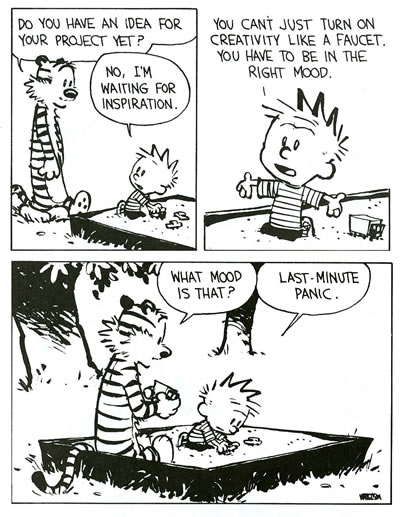
During my creative life cycle, I go through periods where my work loses a sense of play that it previously had. The first time I became conscious of this cycle was during my "aspiring actor" days in high school. My trajectory as an actor went from a kid who loved to get up on stage and revel in trying on unusual skins and squirming around in the moment to a college student, considering acting as a career, who had become concerned with words like "authenticity" and "craft". Ironically, the more I attempted to consciously improve my skills as an actor, the more my acting suffered. I had lost the daring spirit to just play on stage.

A similar thing happened with my drawing. As a child, I filled tablets, rolls of butcher paper and any scrap of drawable surface with an array of material from pencil doodles to full-color, matted works of adolescent art. I still have a lot of my old art, and by 30-something-year old standards, a lot of it is derivative, sloppy, or reflective of a disturbingly violent part of my childhood psyche. I should note that I consider myself an amicable and well-adjusted individual who had an amicable and well-adjusted childhood, but the amount of carnage depicted in my drawings from about age 8-13 would likely have constituted a "credible threat" by today's standards of school-place safety. Anyway, by the time I reached college, I became more concerned with drawing well, and anxious over whether my tendency to sketch eyes and leafless trees was too shallowly emo and whether my love for anime characters with swords was some sort of freudian issue with my subconsciousness. The amount of time I spent drawing began to taper off, and has still not recovered.

The same goes for my writing, though this took a bit longer to fall into the seriousness trap. In college, I made a dedicated decision never to give my academic papers serious titles. All the research and information I needed to convey was in there, but I kept my voice decidedly goofy. I think my professors actually found it to be a breath of fresh air because my grades never suffered for my decision. By the time I reached grad school, however, propriety and proper academic decorum began to weigh heavily upon my voice. I still have my old undergrad papers, and looking back, some of them really hold up well. I have found myself lamenting the apparent decline of that whimsical voice. I think, "damn! that was surprisingly good! What the hell happened?"

And so, now, I find myself going through yet another seriousening, in of all places, my game-mastering for my D&D campaign. I mean, it's a game! It's all about "play", right!? Yet, I find myself struggling to match the creative experimentation that marked my early adventures. It's been years since my players had to talk their way past the pixie highwayman with an addiction to shiny things, or battle the crazed pigs that had broken into Fenwatch's potion shop. My moments of "you know what'd be neat?" have been replaced by endless poring over articles on running efficient combat and plot structuring rubriks. I search for tricks that will help me be "better" instead of letting my inspiration lead the way. Perhaps my awareness of this pattern will help me break out of the funk, but for now, I find myself decidedly mired.

Have any of you experienced a similar counterproductive shift towards perfection over play in your own creative work? If so, what did you do to overcome it?


Friday, July 22, 2011

What is Your Preparation?

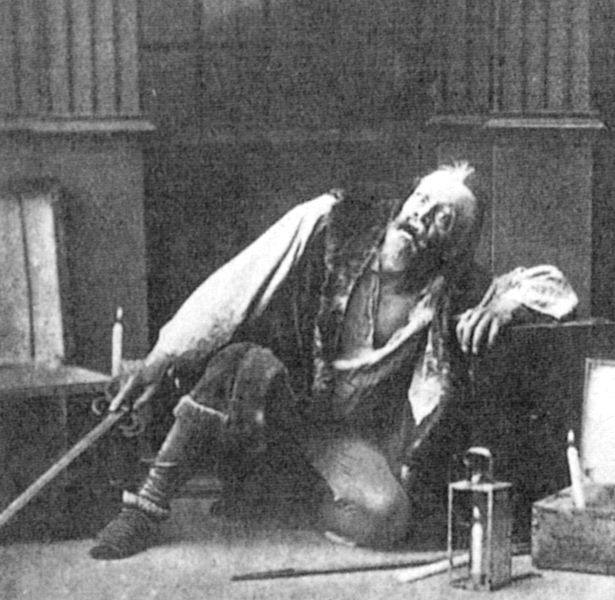
Sad Knight is sad.

Back in college I participated in a study abroad program with the Oxford School of Drama*. One of the acting professors for the program was a grumpy Transylvanian  man named Robert Fried (pronounced fhreed with a slight roll to the 'r'). One of Mr. Fried's favorite utterances, other than various epithets about "penetrating your mother" was, "Vhat is your preparation?" See, Mr. Fried was an adherant of the Stanislavski system of acting, which involves channeling one's own past experiences (read: emotional baggage) into a scene in order to trigger a more "realistic" performance. Now, while this technique represents many of the things I loathe about acTOR culture (narcissism, name dropping/mentor worship, over-psychoanalyzing), learning to develop "triggers" that can inform character choices and drive scenes is a very useful skill for actors, authors and GMs alike.

Early this week, I sat down with a fellow GM for a nerdstorming session to help me plan for my Thursday night game. As we were throwing around ideas for an upcoming encounter, my friend asked, "What is the ideal outcome for this character in this situation?" A light bulb went on, the floodgates opened and mental block walls came crashing down. That one simple sentence "What is the ideal outcome?" was the trigger for which I had been searching.

When I thought about it, it made a tremendous amount of sense. Whenever I find myself faced with a problem, challenge and or conflict, I always have a desired result in mind:

  • My mom will let me have ice cream for dinner
  • The prisoner will come along quietly
  • I'll kill the boar with the first thrust of my spear and the village will have snacks!
If something threatens to derail that ideal, I will drive over around or through the obstacle to try and reach it.


A character's ideal outcome helps inform the tactics he or she will use when faced with a conflict. A lawman who wants to bring a prisoner to justice will likely use different tactics from a bounty hunter whose ideal outcome is getting the reward. Of course, the actual outcome rarely follows the envisioned ideal. The ideal runs face first into obstacles like the environment, lack of resources, and/or the differing ideals of others. Those differences are what generate the conflict and excitement in a scene.

After the nerdstorming discussion, I decided to add a summary of each NPC's ideal outcome into the notes for each encounter I was planning. While preparing for the game, I found this helped me plan for more inherently exciting encounters and to create excitement out of things other than "OGRES! you all draw weapons!" During the actual game, as I played the parts of these NPCs, I kept that ideal firmly in my mind and directed their actions accordingly. Using the ideal as a guidepost helped me feel more comfortable with less preparation and, I felt resulted in some NPC encounters with more nuance and life to them.

Now, "what is the ideal outcome?" might not work as a trigger for everyone. Some people may prefer building their character interactions around props, physical mannerisms, voices or even catch phrases. I have tried all of these with varying degrees of success. Whatever your trigger, I find that having a clear, simple guide point on which you can hang your character helps tremendously in preparing more exciting scenes and then putting them into play.

* It sounds way more prestigious than it actually is as the school is not directly affiliated with any of the Oxford colleges, but is located in Oxfordshire.